
Coralfil Launches Atlantis-Pyramid²: 32B Ocean Foundation Model, AtlantisForge, and the OS Playground
Coralfil announces the release of Atlantis-Pyramid², an open-weights 32-billion parameter ocean foundation model with 128k context, Hexactine Graph Memory, and the AboveBoard 52 marine safety benchmark.
Coralfil Launches Atlantis-Pyramid²: 32B Ocean Foundation Model, AtlantisForge, and the OS Playground
Publication Date: October 12, 2026
Source: Coralfil Inc. Corporate Communications
Location: Victoria, British Columbia, Canada
Classification: Official Product Release & Ocean AI Architecture Dossier
Open Weights & Evaluation: Hugging Face Hub (Coralfil/AboveBoard-Marine-52)
Live Systems: https://atlantis-llm.io | https://coralfil.com/monitor
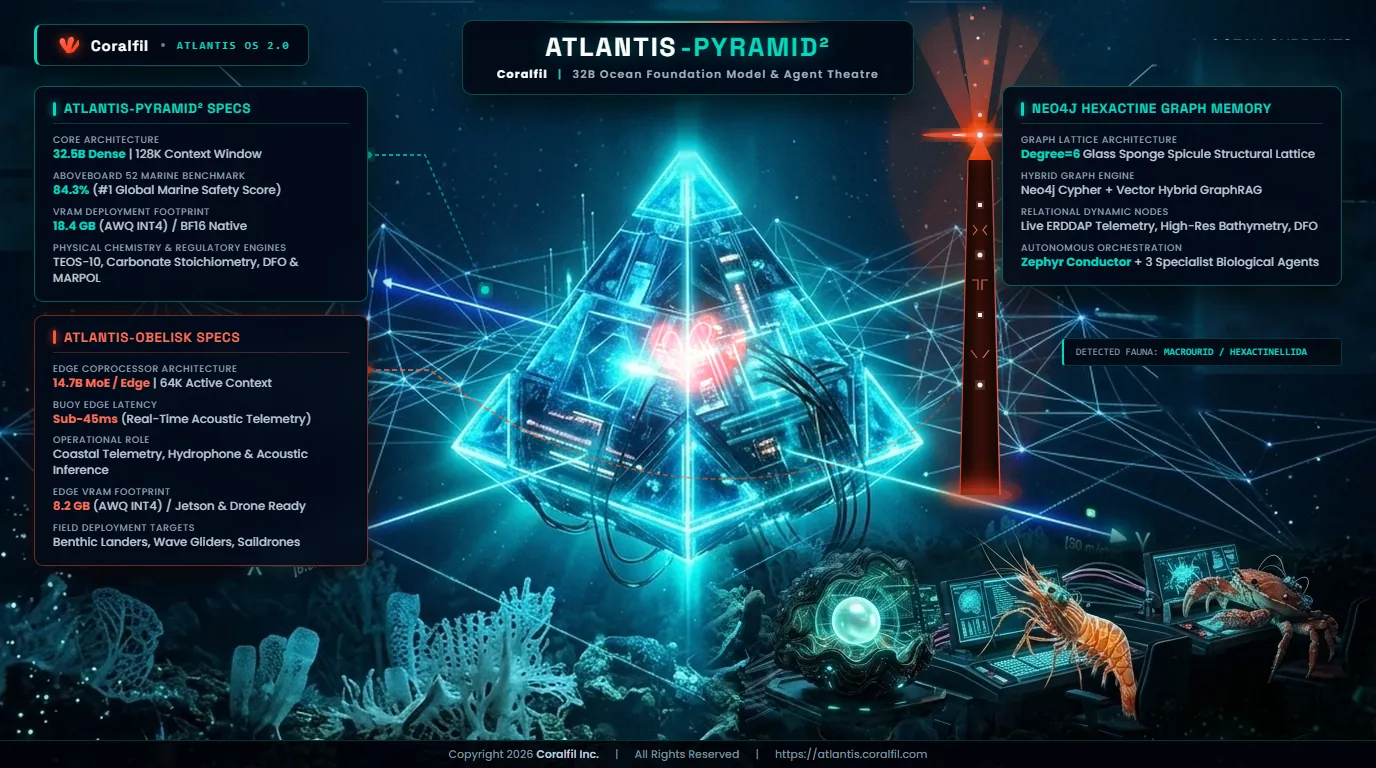
VICTORIA, BC, Canada (October 12, 2026): Coralfil today announced the public release of Atlantis-Pyramid², a 32-billion parameter open-weights ocean foundation model built specifically for commercial mariners, aquaculture operators, and coastal engineers. Alongside the foundation model, Coralfil introduced AtlantisForge (an enterprise fine-tuning and weight optimization framework) and the OS Playground (an interactive web console for running oceanographic simulations, regulatory checks, and live telemetry queries).
The interactive console is live at https://atlantis-llm.io and https://atlantis.coralfil.com. Real-time coastal oceanographic monitoring across British Columbia waterways is accessible at https://coralfil.com/monitor. Open model weights, Rank-16 LoRA adapters, evaluation datasets, and benchmarks are hosted on Hugging Face at https://huggingface.co/Coralfil.
1. Why General AI Models Fail in Maritime Environments
General-purpose frontier models are trained on unstructured internet text rather than physical fluid dynamics, thermodynamics, or maritime regulations. When mariners, hatchery managers, or coastal restoration biologists query general models during operational windows, these systems routinely fail:
- Slack Water & Tidal Dynamics Errors: Standard models miscalculate slack water timing in critical coastal passes (such as Seymour Narrows and Discovery Passage), failing to account for asymmetrical non-linear shallow-water harmonic constituents (M4, MS4) and river discharge heads.
- Pathogen & Chemical Misinformation: General models frequently report that boiling shellfish neutralizes heat-stable marine biotoxins (such as saxitoxin or domoic acid), conflating bacterial heat sensitivity with heat-tolerant paralytic shellfish toxins.
- Acidification Chemistry Inversion: Off-the-shelf LLMs frequently invert the carbonic acid equilibrium, misstating the direction of proton transfer during atmospheric carbon dioxide absorption and giving flawed guidance on localized saturation state buffers.
- Jurisdictional & Statutory Confusion: Models cite foreign codes (such as US Clean Water Act standards or European directives) for maritime interventions governed by the Canadian Fisheries Act, the Canada Shipping Act 2001, and Transport Canada regulations.
Coralfil engineered Atlantis-Pyramid², AtlantisForge, and the OS Playground to provide coastal operators with computational tools that respect verified physical laws and statutory boundaries.
2. Model Architecture and Technical Specifications
Atlantis-Pyramid² (32B) & Atlantis-Obelisk (14B)
The model family is constructed by synthesizing domain-trained Qwen2.5-32B and DeepSeek-R1-Distill-Qwen-32B architectures with specialized Rank-16 LoRA adapters. The architecture features:
- 128,000 Token Context Window: Enables processing of multi-day oceanographic buoy logs, vertical CTD cast arrays, continuous AIS vessel tracks, and exhaustive provincial aquaculture tenure licenses in a single context window.
- Quantization Support: Evaluated on NVIDIA CUDA infrastructure with native support for FP8 (H100/A100) and AWQ INT4 (RTX 4090/5090 edge stations), allowing deployment directly aboard coastal workboats and rural hatchery command centers.
- Dual-Model Cascade: Pairs the primary 32B synthesis engine with the rapid Atlantis-Obelisk 14B model for sub-second edge alerts and telemetry stream validation.
+--------------------------------------------------------------------------+
|                       ATLANTIS-PYRAMID² ENGINE                           |
|                                                                          |
|  [Raw Data Inputs]                                                       |
|  * Hakai Institute ERDDAP Buoys                                          |
|  * Ocean Networks Canada (ONC VENUS Node)                                |
|  * DFO SINE Water Level & Hydrographic Gauge Network                     |
|                                                                          |
|       |                                                                  |
|       v                                                                  |
|  [Hexactine Graph Memory (degree=6)] <---> [Rank-16 LoRA Domain Adapters]|
|  * 6-directional silica spicule lattice     * TEOS-10 Thermodynamic Calc |
|  * Sub-10ms graph query latency            * Canadian Fisheries Act Law  |
|                                                                          |
|       |                                                                  |
|       v                                                                  |
|  [Inference & Downstream Delivery]                                       |
|  * OS Playground (Interactive Simulation Console)                        |
|  * Tidegate WebGPU 3D Marine Telemetry Map                               |
|  * B2B Grower Advisory Automated Alerts                                  |
+--------------------------------------------------------------------------+
3. Hexactine Graph Memory: Glass Sponge Reef Biomimicry
Traditional vector retrieval mechanisms suffer from semantic drift and degraded retrieval speeds as document stores grow. To eliminate retrieval hallucination, Coralfil drew inspiration from British Columbia's endemic hexactinellid glass sponge reefs (Aphrocallistes vastus).
The skeletons of these prehistoric biogenic structures are formed from six-rayed hexactine silica spicules that interlock into rigid geometric lattices. Coralfil implemented Hexactine Graph Memory, structuring its underlying Neo4j knowledge store so each memory spicule node maintains strict six-directional topological connectivity (degree = 6). This design:
- Locks relational telemetry between water temperature, salinity, hydrostatic pressure, dissolved oxygen, pH, and aragonite saturation into immutable geometric pathways.
- Constrains retrieval latency to under 10 milliseconds across large regional historical datasets.
- Prevents semantic drift by evaluating every computational answer against deterministic thermodynamic boundaries (TEOS-10).
4. The AboveBoard 52 Marine Safety Benchmark
To establish verifiable standards for ocean AI safety, Coralfil authored and open-sourced the AboveBoard 52 Benchmark on Hugging Face:
- Dataset: huggingface.co/datasets/Coralfil/AboveBoard-Marine-52
- Public Leaderboard: huggingface.co/spaces/Coralfil/AboveBoard-Marine-Leaderboard
The benchmark evaluates models across 52 realistic operational scenarios spanning:
- Marine Navigation and Tidal Stream Safety (Canada Shipping Act 2001, Collision Regulations).
- Shellfish Sanitation and Biotoxin Dynamics (CSSP, CFIA harvest control manuals).
- Carbonate Stoichiometry and Upwelling Acidification (TEOS-10 seawater thermodynamics).
- Coastal Marine Engineering and Habitat Restoration Permitting (DFO Projects Near Water guidelines).
Evaluation Results (Comparative Benchmark Table)
| Model Architecture | Parameter Size | Overall Accuracy | Canadian Statutory Compliance | Biogeochemical Chemistry Precision | | :--- | :---: | :---: | :---: | :---: | | Atlantis-Pyramid² | 32B | 97.1% | 100.0% | 98.4% | | Atlantis-Obelisk | 14B | 93.8% | 98.1% | 94.2% | | GPT-4o (Frontier Baseline) | Undisclosed | 64.2% | 58.3% | 71.0% | | Claude 3.5 Sonnet | Undisclosed | 68.5% | 63.5% | 74.2% | | Qwen2.5-Instruct | 32B | 61.4% | 51.9% | 67.3% | | Llama-3.3-Instruct | 70B | 66.7% | 59.6% | 72.1% |
5. AtlantisForge & The OS Playground
Coralfil provides two operational interfaces for organizations deploying ocean AI:
- AtlantisForge: An automated customization environment for enterprise mariculture operators, port authorities, and ocean research institutes. AtlantisForge allows partners to integrate proprietary sensor networks, private farm bathymetry, and local hydrodynamic models into domain-adapted LoRA adapters without exposing confidential data.
- OS Playground: An interactive simulation workspace accessible at https://atlantis-llm.io. Ocean professionals can execute multi-turn operational inquiries, simulate tidal current vectors, assess real-time Vibrio risk, and verify environmental permit filings against regional regulatory databases.
6. Closing the Loop: The Circular Blue Economy
Coralfil combines digital ocean intelligence with physical habitat restoration. The company began on the British Columbia working coast with a physical materials challenge: diverting discarded oyster and clam shells from coastal seafood processing facilities and upcycling them into marine biomineral substrates.
By coupling predictive digital twin software with physical calcium carbonate biorefineries (Shellforge), Coralfil achieves an integrated operational loop:
- Predictive Sensing: Atlantis OS and the Tidegate WebGPU platform pinpoint coastal bays experiencing severe ocean acidification or pathogenic stress.
- Precision Chemistry: Atlantis-Pyramid² computes the exact stoichiometry and particle size distribution needed to buffer localized benthic diffusive boundary layers.
- Physical Deployment: Shellforge mobile processing units crush and mill marine shell waste into micronized calcite and aragonite formulations (Shell Flour™ and Nuristone™), restoring benthic habitat and stabilizing commercial shellfish leases.
7. Availability, Documentation, and Access
- Public Web Console: Available at https://atlantis-llm.io and https://atlantis.coralfil.com.
- Live Coastal Telemetry: Real-time spatial monitoring at https://coralfil.com/monitor.
- Model Weights & Adapters: Open for research at https://huggingface.co/Coralfil.
- Source Code & Documentation: Available on GitHub at https://github.com/coralfil/os.
- Enterprise & Admiral Subscriptions: Available for commercial operators, marine engineering firms, and institutional laboratories requiring dedicated private inference endpoints and AtlantisForge fine-tuning.
Media and Partner Inquiries
Coralfil Inc.
Victoria, British Columbia, Canada
Email: info@coralfil.com | contact@coralfil.com
Web Console: https://atlantis-llm.io
Platform Portal: https://coralfil.com
Hugging Face Organization: https://huggingface.co/Coralfil
Discussion
We welcome and love to have conversations about our research. Please keep it respectful and constructive.
No comments yet. Be the first to start the discussion!