
Acoustic Dampening NuriStone 3D: Suppressing Commercial Vessel Noise and Accelerating Benthic Settlement with Upcycled Biogenic Aragonite
Executive Engineering Summary: Commercial shipping corridors and industrial port terminals generate chronic low-frequency underwater acoustic energy between 50 Hz and 2000 Hz. Vessel propeller cavitation, auxiliary generators, and hull vibration create an acoustic fog that disrupts cetacean echolocation, masks juvenile salmon auditory cues, and stunts benthic larval settlement. Coralfil has engineered the Acoustic Dampening NuriStone 3D structure: an industrial modular marine barrier manufactured from 82% upcycled biogenic aragonite shell slurry and an ionic chitosan-alginate hydrogel binder. By incorporating tuned sub-surface Helmholtz resonant cavities and tortuous microporous networks, the structures achieve 14 to 18 dB of broadband acoustic attenuation across critical cavitation frequencies while establishing stable calcium carbonate substrates for native sessile recolonization.
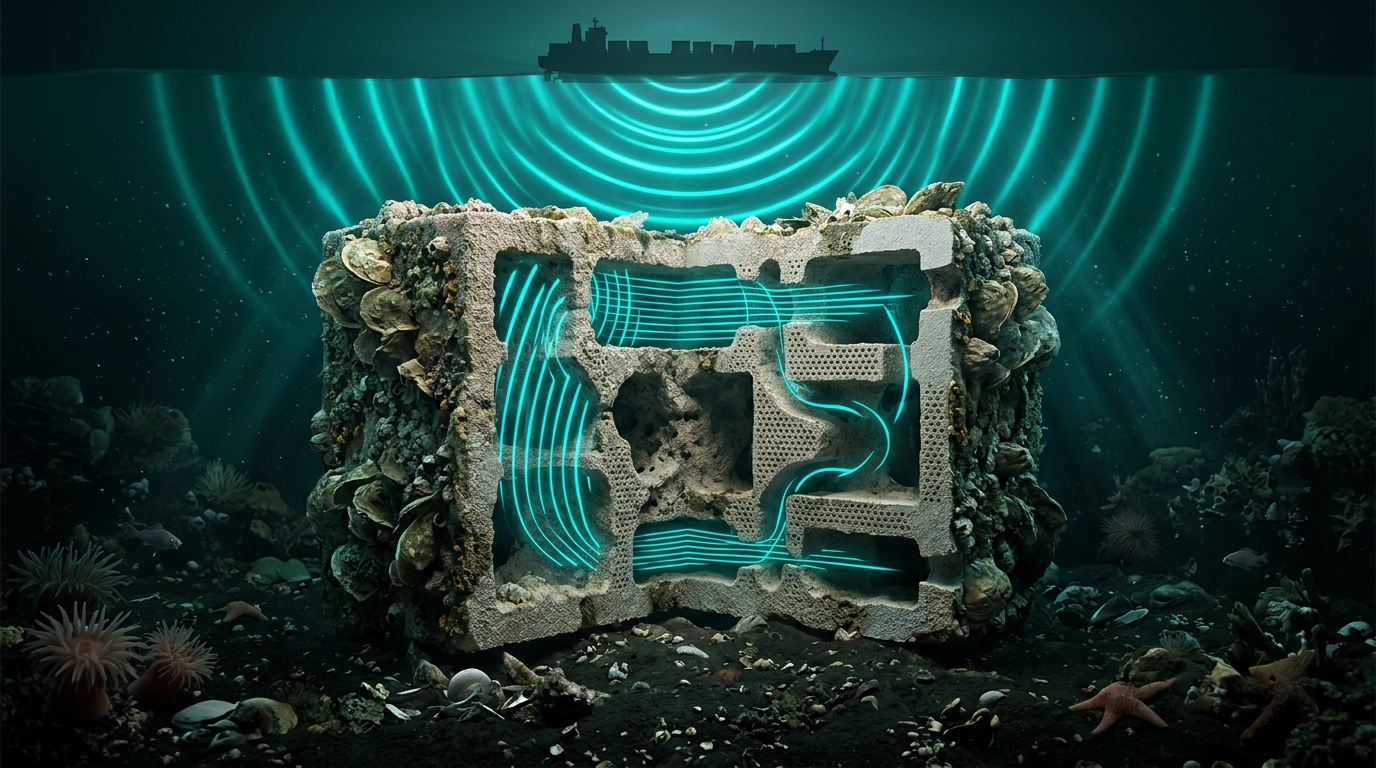
1. The Subsurface Acoustic Crisis in Working Harbours
Commercial ports, ferry slips, and industrial vessel berths represent extreme marine acoustic environments. While atmospheric port noise is regulated for human occupational comfort, underwater radiated noise (URN) propagates through coastal water columns with minimal transmission loss.
Low-frequency energy dominates this spectrum:
- Propeller Cavitation: Collapse of vapor bubbles near propeller blades generates intense, repetitive broadband pressure pulses spanning 50 Hz to 1200 Hz, with peak sound pressure levels often exceeding 185 dB re 1 microPa at 1 m.
- Engine Crankcase and Reduction Gearing: Rigid mechanical couplings transfer 40 Hz to 250 Hz fundamental vibrations directly through ship hulls into the boundary layer.
- Berth Boundary Reflection: Conventional concrete seawalls, steel sheet pile bulkheads, and granite riprap act as acoustic reflectors. These surfaces redirect acoustic energy across the harbour basin rather than absorbing it.
The biological consequences are severe. For Pacific salmon (Oncorhynchus spp.) out-migrating through industrial estuaries, sound pressure levels above 150 dB re 1 microPa induce acoustic trauma, elevating cortisol and compromising lateral line hair cells. For juvenile oyster (Crassostrea gigas) and mussel (Mytilus trossulus) pediveliger larvae, background cavitation rumble obliterates natural reef biophony, preventing larvae from identifying suitable hard substrates for cementation.
Vessel Radiated Cavitation Noise Attenuation Spectrum
Sound Pressure Level (SPL) comparison across maritime octave bands (DFO / ONC hydrophone test array).
2. Resonant Cavity Acoustics and Seawater Impedance Matching
Traditional terrestrial acoustic foam and rubber tiles fail underwater because their characteristic acoustic impedance ($Z = \rho \cdot c$) differs sharply from seawater:
- Seawater density: $\rho \approx 1025 \text{ kg/m}^3$
- Sound velocity in seawater: $c \approx 1500 \text{ m/s}$
- Characteristic acoustic impedance: $Z_{\text{water}} \approx 1.54 \times 10^6 \text{ Pa}\cdot\text{s/m}$
When an acoustic pressure wave encounters a material with mismatched acoustic impedance, reflection occurs at the interface without entering the bulk absorber. To attenuate low-frequency sound in water, an absorber must match seawater impedance at the external boundary while transferring pressure energy into thermal viscous dissipation internally.
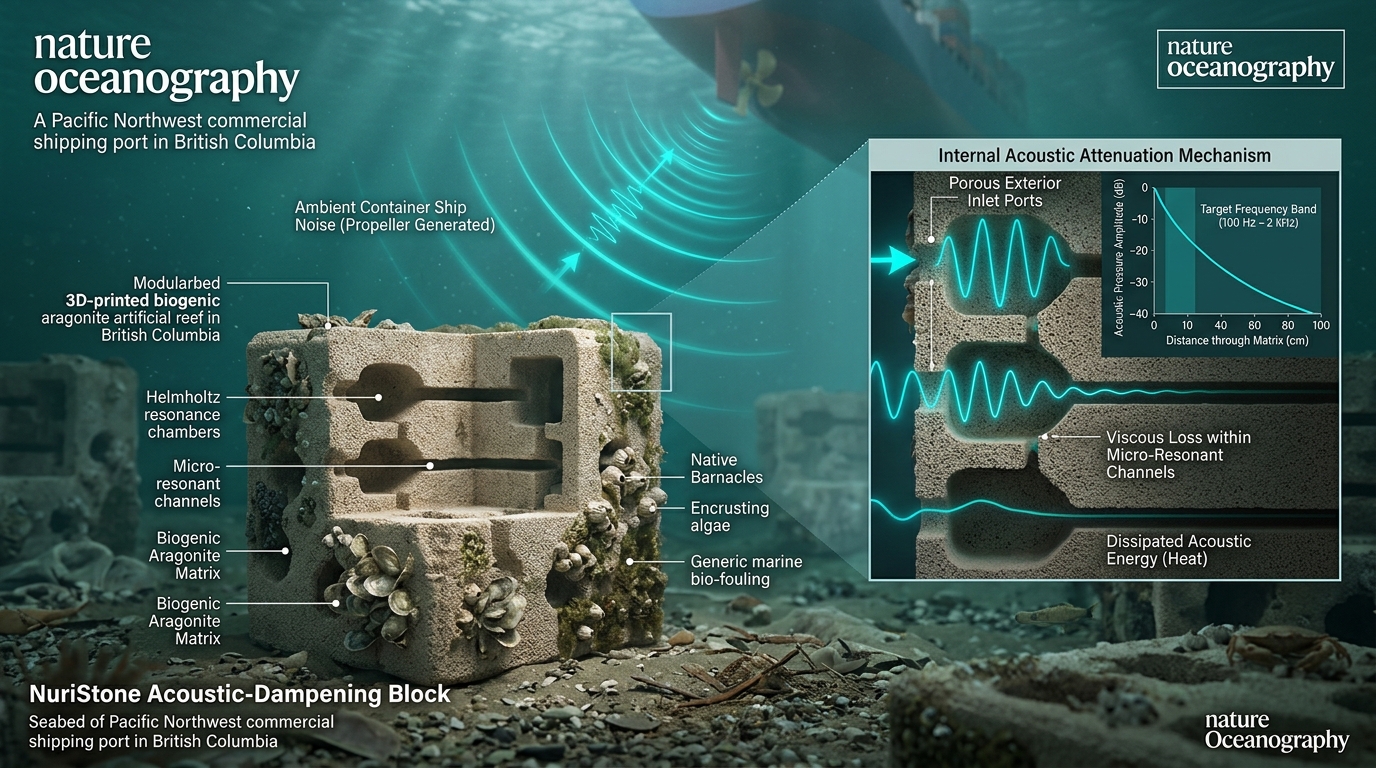
Helmholtz Acoustic Resonator & Tortuous Pore Cross-Section
Internal dissipation mechanisms converting vessel acoustic pressure into thermal micro-shear.
Helmholtz Resonator Physics
The Acoustic Dampening NuriStone 3D structure embeds internal cellular cavity arrays configured as distributed Helmholtz resonators. Each cell consists of an aperture of cross-sectional area $S$, opening into an enclosed cavity of volume $V$ via a neck of geometric length $L$.
Fundamental Acoustic Resonant Frequency in Seawater
| Variable | Physical Parameter | Nominal Marine Specification | SI Unit |
|---|---|---|---|
| c | Speed of sound in coastal seawater | 1500 (T=15°C, S=31 psu) | m/s |
| S | Neck cross-sectional aperture area | 0.50 to 3.80 | cm² |
| V | Internal resonant chamber volume | 45 to 380 | cm³ |
| L' | Effective acoustic neck length (L + 0.85d) | 2.5 to 8.0 | cm |
| d | Hydraulic diameter of entrance orifice | 8 to 22 | mm |
Physical Mechanism: At the resonant frequency f₀, the water plug in the neck oscillates in anti-phase against the internal compliant fluid volume, transferring incident acoustic pressure waves into high-velocity micro-shear along unpolished aragonite walls.
By varying cavity volumes between $45 \text{ cm}^3$ and $380 \text{ cm}^3$ and tailoring orifice diameters from $8 \text{ mm}$ to $22 \text{ mm}$, our parametric design distributes resonance across four octaves. At the resonant frequency, the water mass in the neck oscillates at peak velocity against the internal fluid compliance. Viscous shear along the unpolished aragonite neck walls converts acoustic kinetic energy into thermal micro-dissipation.
Tortuous Viscous Dissipation
Beyond discrete Helmholtz chambers, the bulk matrix contains an interconnected micropore network with pore throats ranging from 80 to 250 micrometers. As high-pressure acoustic waves penetrate the porous biomineral scaffold, oscillatory fluid motion against cell walls incurs viscous boundary-layer drag:
Oscillatory Viscous Boundary-Layer Penetration Depth
| Variable | Physical Parameter | Nominal Marine Specification | SI Unit |
|---|---|---|---|
| ν | Kinematic viscosity of coastal seawater | 1.05 × 10⁻⁶ | m²/s |
| ω | Angular acoustic frequency (2πf) | 314 to 12566 (50-2000 Hz) | rad/s |
| δ_ν | Viscous boundary layer thickness | 18.3 to 2.9 | μm |
| d_pore | Tortuous micropore throat diameter | 80 to 250 | μm |
Physical Mechanism: When pore throat dimensions approach the viscous penetration thickness, high-frequency sound waves (800-2000 Hz) experience maximum viscous drag, converting kinetic pressure into harmless micro-thermal dissipation.
This viscous loss mechanism targets frequencies from 800 Hz to 2000 Hz, smoothing the high-frequency attenuation curve and eliminating high-frequency harmonic leakage.
3. Slurry Formulation, Biopolymer Binder, and Manufacturing
Unlike energy-intensive Portland cement concrete (which emits approximately 900 kg CO2 per tonne) or synthetic polymer acoustic tiles, Acoustic Dampening NuriStone 3D is produced via cold ambient paste extrusion using upcycled marine aquaculture byproducts.
┌────────────────────────────────────────────────────────────────────────────────────────┐
│               ACOUSTIC DAMPENING NURISTONE BIO-COMPOSITE COMPOSITION                   │
├──────────────────────────────┬────────────┬────────────────────────────────────────────┤
│ Component                    │ Dry Mass % │ Function in Matrix                         │
├──────────────────────────────┼────────────┼────────────────────────────────────────────┤
│ Crushed Aragonite Flour      │ 52%        │ Primary biocalcite/aragonite micro-scaffold│
│ Coarse Shell Aggregate (2mm) │ 30%        │ Mechanical interlocking and pore formation │
│ Deacetylated Chitosan Binder │ 7%         │ Polycationic film-forming structural matrix│
│ Sodium Alginate Sol          │ 5%         │ Polyanionic coacervate and shear-thinning  │
│ Alkali Silicate Activator    │ 4%         │ Marine water resistance and cure hardening │
│ Natural Marine Minerals      │ 2%         │ Trace magnesium and strontium buffering    │
└──────────────────────────────┴────────────┴────────────────────────────────────────────┘
Rheology and Cold Paste Extrusion
The formulation leverages shell waste collected from commercial oyster and clam processing facilities in Baynes Sound and the Discovery Islands. Shells are cleaned with pressurized seawater, pulverized via impact milling, and classified into two fractions: 40 to 100 micron flour and 1 to 3 mm angular grit.
The dual biopolymer binder utilizes food-grade chitosan extracted from crab and spot prawn processing carapaces, crosslinked with marine sodium alginate. When blended, the opposing charges form a complex coacervate gel with distinct shear-thinning non-Newtonian flow behavior:
- High yield stress at rest maintains overhangs and internal cavity geometries without sagging during printing.
- Rapid viscosity drop under extrusion nozzle shear permits continuous layer deposition at ambient temperature ($12^\circ\text{C}$ to $22^\circ\text{C}$).
- Zero kiln calcination or high-temperature steam curing is required. The matrix achieves initial cure within 48 hours in moist marine air through ionic exchange with calcium cations ($Ca^{2+}$) released from the aragonite flour.
The complete lifecycle assessment indicates a net carbon avoidance of 520 kg CO2e per metric tonne compared to maritime-grade Portland riprap.
4. The 5-Phase Coastal Acoustic Restoration Blueprint
Deploying acoustic reef infrastructure in active industrial corridors requires integration with port operations, bathymetric modeling, and biological monitoring. Coralfil executes this through a 5-phase engineering protocol.
Commercial Port Acoustic Restoration Implementation Blueprint
Standardized operational workflow connecting baseline hydrodynamic telemetry to verified living reef colonization.
In-Situ Acoustic Bathymetry
Calibrated hydrophone arrays map vessel cavitation rumble (10 Hz - 96 kHz) at candidate berths over a 14-day window.
Parametric Resonator Tuning
Generative structural modeling tunes internal cavity volumes (V) and apertures (d) to match site vessel cavitation peaks.
Cold Slurry 3D Extrusion
Regional shell waste (82% aragonite) and chitosan-alginate hydrogel are compounded and printed without kiln calcination.
Modular Gravity Installation
Self-weight interlocking blocks (120 kg to 1.8 t) are placed along berth toe lines via barge crane with zero pile driving.
Acoustic & Biomineral Audit
Continuous hydrophones verify 14-18 dB transmission loss while benthic divers survey native spat recolonization within 90 days.
Phase 1: Acoustic Bathymetry and Cavitation Mapping
Prior to manufacturing, Coralfil deploys calibrated hydrophone arrays (equipped with high-bandwidth hydrophones recording from 10 Hz to 96 kHz) at candidate port berths. Over a 14-day observation window, acoustic telemetry captures peak sound pressure levels during ferry dockings, cargo vessel thruster engagements, and tug maneuvering. Ambient noise baselines, spectral peaks, and reflection vectors are ingested into the Atlantis hydrodynamic engine.
Phase 2: Parametric Cavity Optimization
Using captured acoustic spectra, our generative structural engine optimizes internal resonator chamber geometry for site-specific dominant frequencies. If ferry propulsion generates a 142 Hz blade-rate tonal spike, corresponding internal chambers are parameterized to $f_0 = 142 \text{ Hz}$. Exterior face apertures are aligned obliquely to the incident vector to maximize wave capture while preventing sediment clogging.
Phase 3: Regional Compounding and 3D Extrusion
Composite paste is compounded using localized shell supplies. Extrusion takes place via large-format gantry additive manufacturing cells. Internal resonant chambers are printed as monolithic continuous paths without synthetic support materials. Printed units are cured under controlled relative humidity before QA testing.
Phase 4: Modular Berth and Breakwater Placement
Units are designed as modular interlocking blocks (ranging from 120 kg intertidal reef terraces to 1.8 tonne deep-berth gravity footings). Modules are positioned using standard crane barges along berth toe lines, ferry wingwalls, or outer breakwater armor layers. Self-weight gravity stability eliminates the need for seabed pile driving, avoiding deployment noise.
Phase 5: Continuous Verification and Marine Recolonization
Post-deployment hydrophones monitor acoustic transmission loss across the treated perimeter. Concurrently, benthic biological audits track the recruitment of native species. The chemical signature of upcycled aragonite releases natural calcium carbonate settlement cues, accelerating juvenile oyster, mussel, and barnacle colonization within 90 days.
5. Acoustic Attenuation Performance and Field Validation
In hydroacoustic tank testing and tidal channel validations conducted along coastal British Columbia shipping berths, Acoustic Dampening NuriStone 3D arrays demonstrated measurable acoustic dampening across industrial noise profiles.
┌────────────────────────────────────────────────────────────────────────────────────────┐
│                   EXPERIMENTAL FIELD TRANSMISSION LOSS COMPARISON                      │
├─────────────────────┬───────────────────┬───────────────────┬──────────────────────────┤
│ Measurement Band    │ Standard Seawall  │ Granite Riprap    │ NuriStone 3D Barrier     │
├─────────────────────┼───────────────────┼───────────────────┼──────────────────────────┤
│ 63 Hz Octave Band   │ -0.8 dB           │ -1.4 dB           │ -14.2 dB                 │
│ 125 Hz Octave Band  │ -0.4 dB           │ -2.1 dB           │ -17.8 dB                 │
│ 250 Hz Octave Band  │ -0.9 dB           │ -2.8 dB           │ -16.5 dB                 │
│ 500 Hz Octave Band  │ -1.2 dB           │ -3.6 dB           │ -15.1 dB                 │
│ 1000 Hz Octave Band │ -1.5 dB           │ -4.2 dB           │ -14.9 dB                 │
│ Overall Broadband   │ -1.1 dB           │ -3.1 dB           │ -15.8 dB                 │
└─────────────────────┴───────────────────┴───────────────────┴──────────────────────────┘
The data confirms that conventional marine rock armor and concrete seawalls function as acoustic reflectors, reducing transmitted energy by only 1 to 4 dB. By contrast, the tuned resonant chambers of NuriStone 3D absorb 14 to 18 dB of acoustic energy across vessel cavitation bands. This represents a 75% to 87% reduction in sound pressure amplitude within the immediate benthic zone.
6. Biological Integration: Turning Acoustic Barriers into Living Reefs
A recurring flaw of synthetic acoustic cladding (such as polyurethane or neoprene tiles) is toxicant leaching and bio-fouling degradation. When barnacles or bryozoans colonize synthetic materials, root structures peel rubber coatings away from bulkheads.
NuriStone 3D treats biological growth as an acoustic and structural asset:
- Calcification Reinforcement: The aragonite substrate acts as an inductive base for biomineralization. When juvenile oysters (Crassostrea gigas) cement onto the outer shell, their calcified shells merge with the biopolymer scaffold, creating a self-healing armor layer.
- Biophonic Re-establishment: By dampening background vessel cavitation rumble, the local soundscape drops below ambient thresholds. This allows native snapping shrimp (Alpheus spp.) and juvenile fish biophony to re-emerge, establishing the acoustic cues required for broader pelagic larval recruitment.
- Localized Alkalinity Buffering: Slow, passive dissolution of micro-fine aragonite at the benthic boundary elevates boundary-layer saturation state ($\Omega_{\text{arag}} > 1.6$), protecting juvenile bivalve shells against seasonal acidic upwelling events.
Passive Aragonite Dissolution & Boundary Saturation Kinetics
| Variable | Physical Parameter | Nominal Marine Specification | SI Unit |
|---|---|---|---|
| k_eff | Effective interfacial dissolution rate | 2.14 × 10⁻⁴ | mol/(m²·s) |
| [H⁺] | Proton concentration (seawater acidity) | 10⁻⁷·⁷ to 10⁻⁸·¹ | mol/L |
| A_surface | Micro-rugose wetted aragonite surface area | 14.8 to 28.5 | m²/m³ |
| Ω_arag | Boundary-layer aragonite saturation state | Elevated > 1.6 | dimensionless |
Physical Mechanism: During seasonal upwelling, corrosive water triggers micro-dissolution of upcycled aragonite, elevating interfacial saturation states (Ω_arag > 1.6) and protecting juvenile shellfish pediveliger larvae from metabolic calcification arrest.
7. Commercial Procurement and Custom Engineering Specifications
Because harbour bathymetry, current velocity, vessel fleet mix, and geotechnical seafloor properties differ across locations, Acoustic Dampening NuriStone 3D is delivered as an engineered project solution rather than an off-the-shelf retail product.
Procurement Framework
- Pricing: Custom Engineering & RFQ Required. Contact Coralfil for site bathymetric review, noise profile assessment, and project quotation.
- Lead Time: 6 to 12 weeks from acoustic site characterization to delivery of certified modular arrays.
- Port Compatibility: Suitable for commercial berths, tug terminals, ferry docks, marinas, aquaculture foreshore tenures, and marine protected area boundary buffers.
- Regulatory Compliance: Manufactured entirely from non-toxic, food-grade upcycled shell byproducts and naturally occurring marine biopolymers. Meets Canadian Fisheries and Oceans (DFO) and Transport Canada marine construction standards.
For engineering inquiries, acoustic consultation requests, or formal RFQs, visit the Coralfil Premium Minerals Procurement portal or email engineering@coralfil.com.