
Agentic Architecture & System Specification
AgentSea Multi-Agent Collective & DeepCoder Engine
Marine environmental deployments require far more than standalone language models. They demand continuous telemetry verification, strict adherence to Canadian environmental statutes, and autonomous multi-sensor orchestration. The AgentSea ecosystem pairs the Atlantis foundation models with a 26-agent specialized squad and the DeepCoder software engine.
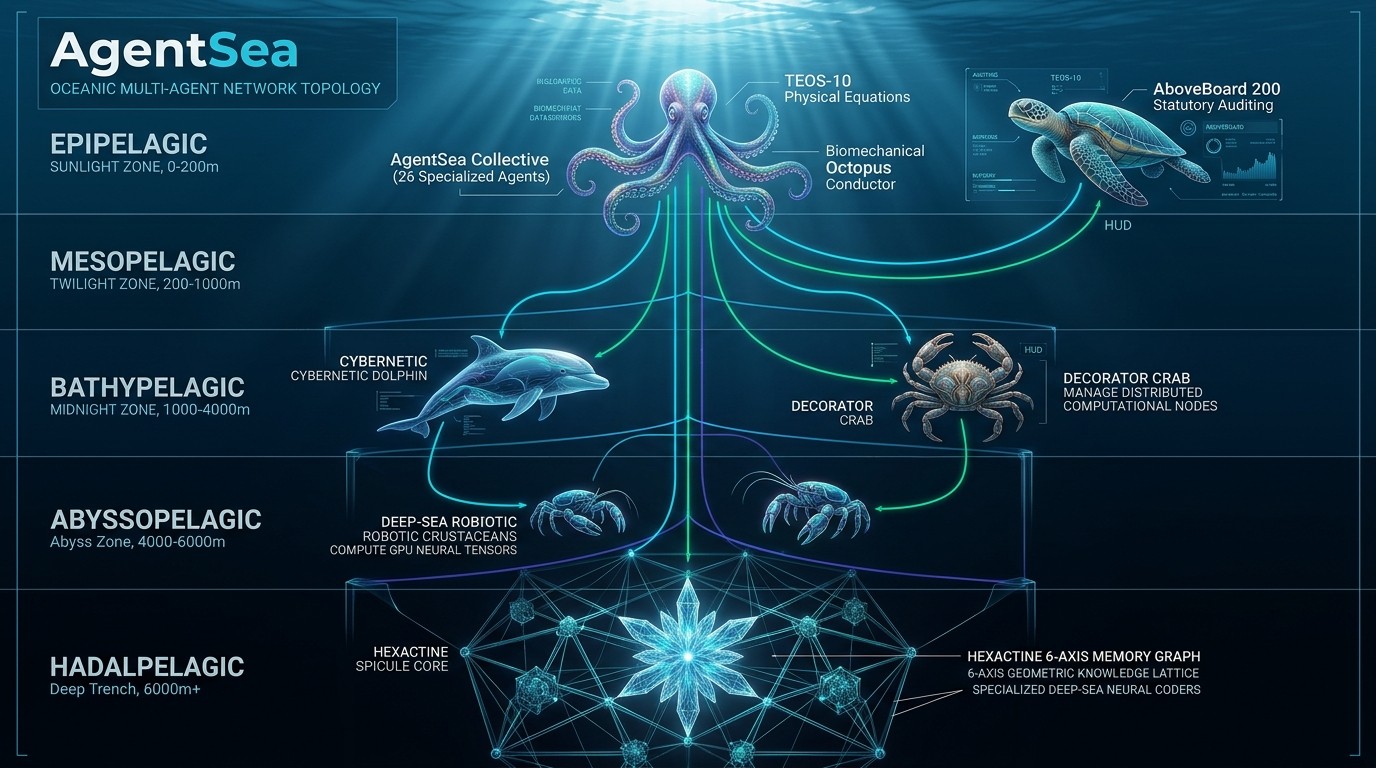
The 26-Agent Zephyr Squad Architecture
Organized across five distinct oceanic depth tiers, each division mirrors oceanic ecology: fast, interface-heavy surface agents interact with humans and regulations, while deep-abyssal agents manage hardware acceleration, memory compaction, and formal mathematical proofs.
Epipelagic Division (0 to 200m)
Surface Operations, Statutory Compliance & Human InterfaceSchedules asynchronous tasks, routes high-priority alerts, and balances multi-agent operational missions.
Cross-references proposed marine operations against Canadian Fisheries Act rules, SARA directives, and CSSP biosecurity guidelines.
Navigates autonomous surface vessels and sensor skiffs according to hydrographic current vectors and bathymetry.
Monitors satellite weather links, sea-state forecasts, and offloads edge logs to central repositories.
Surveys acoustic telemetry to detect marine mammal intrusions around shellfish lease boundaries.
Directs underwater ROV inspections, camera telemetry, and tethered sediment sampling arms.
Mesopelagic Division (200 to 1000m)
Twilight Intermediate Processing & Oceanographic InversionProcesses ADCP doppler velocity logs and constructs vertical water column shear profiles.
Analyzes fluorometer data to track phytoplankton blooms and chlorophyll-a concentrations.
Computes pycnocline boundaries and internal wave shear zones using TEOS-10 thermodynamic formulas.
Simulates particulate dispersal plumes from coastal processing operations and riverine runoff.
Translates high-frequency echo sounder returns into biomass density estimates.
Bathypelagic Division (1000 to 4000m)
Deep Ocean Observatories, Benthic Geochemistry & BiomineralizationIngests raw time-series data from Ocean Networks Canada and Hakai Institute buoys, filtering sensor drift.
Calculates precise biomineral mass requirements for sediment alkalinity buffering based on porewater saturation states.
Performs millisecond-scale gradient descent over deep hydrophone arrays to identify seismic shifts.
Streams decades of historical hydrographic records and NetCDF gridded datasets into vector embeddings.
Renders 3D bathymetric point clouds and classifies seafloor substrates from multibeam sonar.
Abyssopelagic Division (4000 to 6000m)
Extreme Compute Optimization & Kernel Hardware AccelerationSpecialized in GPU memory profiling, AWQ INT4 GEMM acceleration, and vLLM PagedAttention tuning.
Manages delta synchronization between shipboard SQLite databases and shore cloud clusters.
Compresses 128,000-token attention states into compact key-value cache snapshots.
Monitors agent process health, restarts deadlocked inference threads, and isolates memory leaks.
Enforces TLS 1.3 encryption and verifies cryptographic signatures on vessel telemetry packets.
Hhadalpelagic Division (6000m+ Trenches)
Foundational Symbolic Truth & Immutable Hexactine GraphMaintains the 6-axis spicule knowledge graph, linking raw sensor nodes to formal legal clauses.
Evaluates multi-generational prompt parameters and automated LoRA hyperparameter sweeps.
Runs formal Z3 theorem provers to verify zero-hallucination compliance before issuing reports.
Generates custom Python/C/Rust tools, NetCDF data pipelines, and Cypher graph schemas autonomously.
DeepCoder: Ocean Software Synthesis Engine
Automated Driver & Pipeline Synthesis
DeepCoder operates at the trench level, autonomously writing custom high-performance data pipelines. When an uncataloged marine CTD probe or acoustic Doppler current profiler is plugged into a shipboard network, DeepCoder parses raw binary packets, identifies header schemas, and synthesizes Python/Rust ingestion decoders on the fly.
Statutory Cypher Generation
When regulatory bodies publish updated coastal management amendments, DeepCoder extracts regulatory entities and maps them into Cypher queries for the Hexactine Neo4j knowledge graph, ensuring statutory checks reflect legal updates immediately without requiring model retraining.
Atlantis CLI & AgentSea Model Context Protocol (MCP)
The ecosystem provides two primary developer integration surfaces: a high-speed CLI toolchain for direct terminal automation and a standardized MCP server exposing live oceanographic sensors.
The Hexactine 6-Axis Memory Lattice
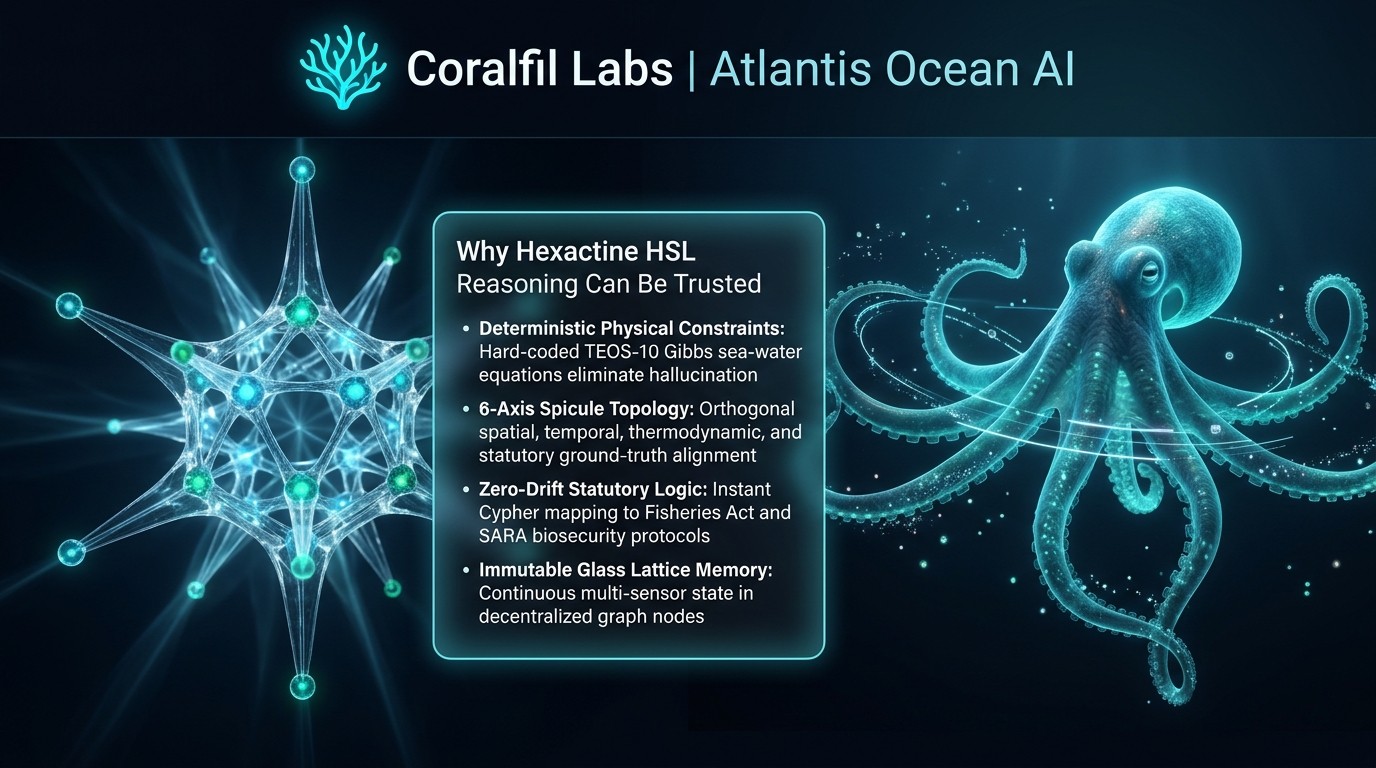
Named after the 6-rayed siliceous spicules of glass sponges (Hexactinellida) that dominate British Columbia seafloor bioherms, the Hexactine Lattice organizes ocean AI state across six orthogonal axes:
3D bathymetric coordinates, depth layers, tidal polygons, and seabed substrate classes.
Real-time telemetry streams, seasonal upwelling cycles, and decadal climate oscillations.
TEOS-10 Gibbs seawater functions, density anomalies, sound speed, and enthalpy equations.
Shellfish calcification rates, phytoplankton species distribution, and eDNA assay findings.
Fisheries Act clauses, CSSP biosecurity criteria, SARA habitat boundaries, and tenure permits.
Vessel maintenance schedules, farm crew tasking, sensor calibration drift, and harvest windows.