
Materials Research
Shellforge: Modular 2x20 Roll-On/Roll-Off Marine Biorefinery
Shellforge brings biomineral processing directly to coastal landing docks and seafood processing hubs. Packaging washing, acoustic cavitation, sterilization, supersonic vortex milling, and biopolymer fractionation into two 20-foot intermodal shipping containers (a 2x20 modular footprint) enables roll-on/roll-off coastal transport to remote working waterfronts.
Modular 2x20 Intermodal Engineering Architecture
Aquaculture shell waste is heavy, wet, and dispersed across rural coastal hatcheries and depuration plants throughout the Pacific Northwest. Transporting raw wet shell long distances is carbon-intensive, odor-prone, and economically unviable.
Rather than relying on a single immobile 40-foot container that requires heavy harbor cranes, Shellforge deploys as two connected 20-foot ISO intermodal containers (a 2x20 architecture). This allows operations to scale flexibly and relocate across coastal landing sites as seasonal shellfish harvests shift:
- Module A (Preparation, Cavitation & Dewatering): Houses raw shell hopper intake, ultrasonic cavitation baths, recirculating wash filtration, and primary mechanical sizing.
- Module B (Flash Sterilization, Micronization & Chitin Extraction): Houses fluid-bed thermal flash sterilization, supersonic pneumatic vortex milling, cyclone particulate collectors, and enzymatic extraction loops.
Roll-On / Roll-Off (RoRo) Coastal Logistics
The 2x20 modular architecture is specifically engineered for Roll-on/Roll-off (RoRo) marine logistics. Each 20-foot container can be driven directly onto shallow-draft landing craft, coastal landing barges, and roll-on freight ferries serving Vancouver Island, the Sunshine Coast, and Haida Gwaii.
This footprint enables landing at unpaved gravel ramps, floating docks, and remote processing facilities without requiring 50-ton mobile port cranes. Once landed, quick-connect umbilical conduits couple power, process water, and telemetry between the two modules within four hours of arrival.
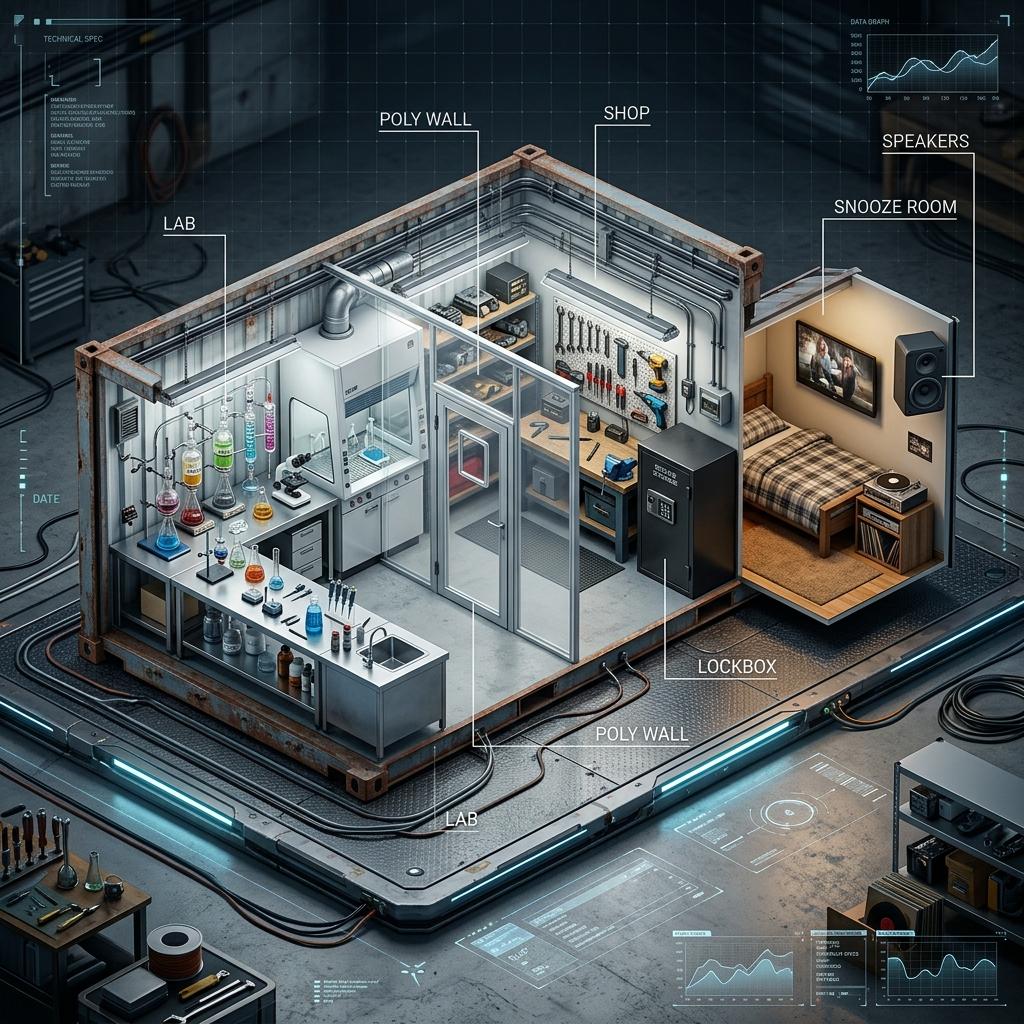
Interior Biorefinery Layout and Flow
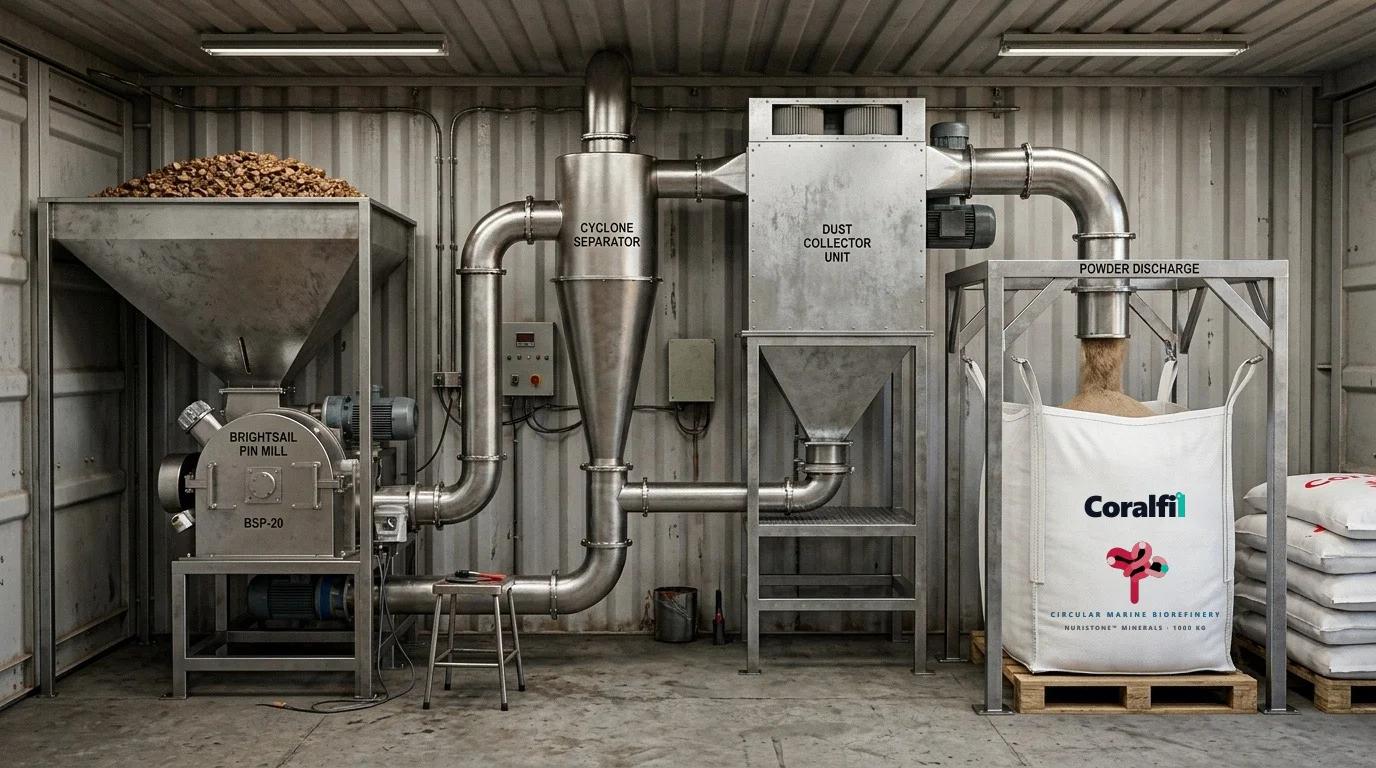
Five-Stage Refining Pipeline
Stage 1: Acoustic cavitation and organic biofilm removal (Module A)
Ultrasonic transducers strip residual organic tissue and marine biofilm without harsh synthetic solvents or acid baths, keeping the underlying aragonite and calcite crystal lattice intact.
Stage 2: Primary mechanical sizing and dewatering (Module A)
Low-shear mechanical crushing fractures cleaned shells into calibrated chips while high-efficiency centrifugal filters separate porewater for closed-loop filtration.
Stage 3: Fluid-bed thermal flash sterilization (Module B)
A closed-loop dry thermal flash process neutralizes marine pathogens and microbial contaminants, meeting Canadian Food Inspection Agency (CFIA) and Fisheries and Oceans Canada (DFO) biosecurity thresholds.
Stage 4: Supersonic vortex jet-milling and micronization (Module B)
Compressed-air vortex milling drives particle-on-particle collisions to achieve uniform particle size distribution without thermal crystal degradation, yielding micronized shell flour down to 45 microns.
Stage 5: Enzymatic chitin and protein fractionation (Module B)
Mild enzymatic separation isolates high molecular weight chitin polymers and marine bioactive peptides from crab and spot prawn carapaces, operating with zero wastewater discharge.
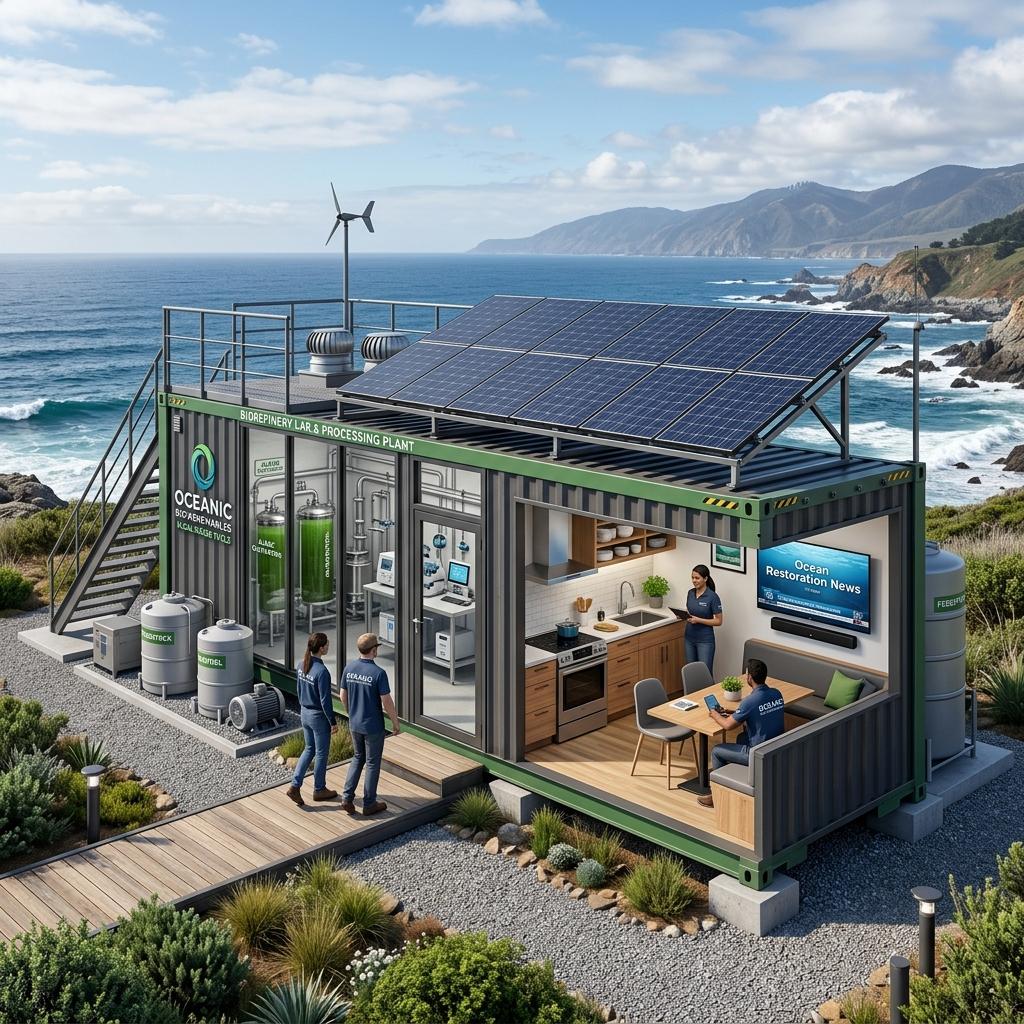
Self-Contained Deployment and Auxiliary Power
Biomaterial End Products
The Shellforge refining circuit produces three distinct commercial and research biomineral outputs:
- Shell Flour (45-125 um): High-surface-area calcium carbonate for rapid chemical porewater buffering in juvenile bivalve nurseries and agricultural soil revitalization.
- Graded Cultch (2-15 mm): Washed and sterilized substrate for wild oyster reef recruitment, larval setting plates, and coastal clam garden terraces.
- Crustacean Chitin: Deacetylated precursor polymers used in developing biodegradable bio-adhesives, protective films, and Nuristone biocomposite matrices.