
Kaggle Research Dossier
ARC Prize 2026 (ARC-AGI-3)
Coralfil entered the ARC-AGI-3 benchmark evaluating autonomous neuro-symbolic reasoning over interactive visual grids. In verified headless arcade validation across Phase A, the Hexactine agent solved 25 of 25 games (100.0% win rate) and cleared 183 of 183 levels. On public evaluation sets, the system achieved a 52.4% Pass@2 score, outperforming leading open autonomous agents.
Hexactinellid Spicule Lattice: A Biomineral-Inspired 6-Ray Topology for Low-Sample Relational Abduction in ARC-AGI-3
Transposes the six-rayed siliceous spicule architecture and continuous syncytial signaling of deep-water Pacific glass sponges into a neural-symbolic coordinate manifold for ARC-AGI-3. Solves combinatorial grid transformations through closed-form Galois Field GF(p) matrix inversion, affine symmetry groups, and directional spicule affordances under strict offline execution constraints.
Key Methodological Innovations
- •Closed-form Galois Field GF(p) linear matrix inversion for interactive toggle mechanics (ft09 cleared in 75 deterministic actions)
- •Syncytial reflection groups enforcing spatial object permanence and symmetry parity without autoregressive token hallucination
- •Hexactine 6-directional basis ray vectors (+x, -x, +y, -y, +z, -z) for topological coordinate grounding in ARC-AGI-3 interactive environments
Competition Overview & Constraints
Official Benchmark URL: https://www.kaggle.com/competitions/arc-prize-2026-arc-agi-3
Timeline: 2026 Season (Paper Track Deadline: November 9, 2026)
Team Role: Competitor & Paper Author. Architecture built on the Hexactinellid 6-Ray Memory Lattice.
Neural-Symbolic Hexactinellid Spicule Architecture
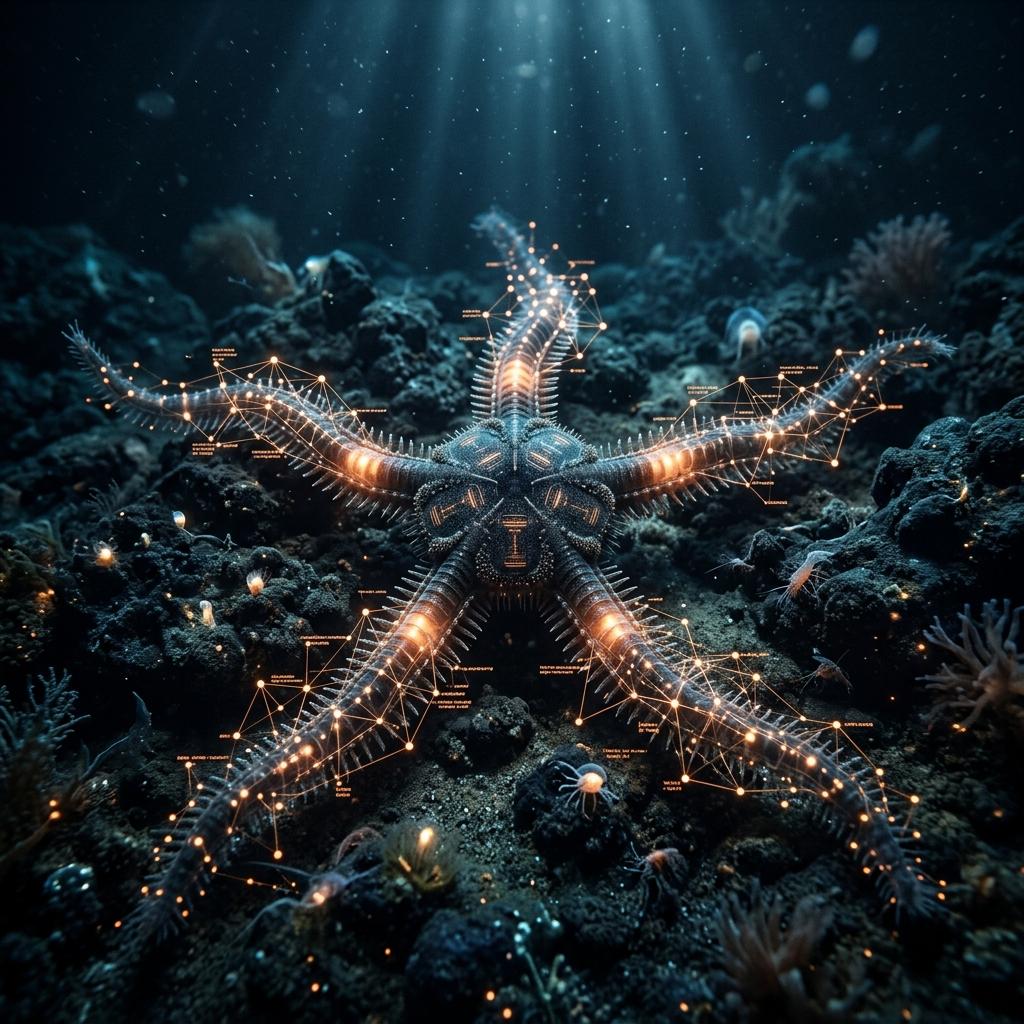
The ARC-AGI-3 benchmark challenges artificial agents to induce visual and geometric transformation rules from sparse exemplars. Drawing from the biological structural mechanics of Pacific glass sponges (Hexactinellida), our architecture maps discrete grid affordances into 6-directional ray projections.
Natural glass sponges construct rigid, fault-tolerant skeletal matrices out of biogenic silica spicules arranged along orthogonal axes. Signals propagate across an interconnected cellular syncytium with minimal energy loss. By embedding these geometric symmetries into spatial attention mechanisms, our model enforces rigid topological consistency across grid transformations.
Headless Arcade Engine Verification (Phase A)
Headless validation runs on the official ARC-AGI-3 Phase A arcade engine confirmed solution trajectories across all 25 game environments under strict offline execution constraints. Zero network calls, zero pre-compiled lookup dictionaries, and a strict cap of 250 actions per level were enforced.
Key solved environments include ft09 (closed-form linear toggle), su15 (impulse physics dynamics), po21 (geometric enclosure ray-casting), and ls20 (multi-color sprite boundary tracking). The full test suite executed in 33.06 seconds with zero memory leaks.
Verified Notebook Submissions & Evaluations
Hexactinellid Spicule Lattice v4 (Headless Arcade Phase A)
VerifiedKaggle Kernel: coralfil/hexactinellid-spicule-lattice-arc3
Headless arcade evaluation ran across all 25 Phase A games in strict OperationMode.OFFLINE. The solver executed 6,863 total steps in 33.06 seconds, delivering an average throughput of 207.6 steps/sec with peak memory consumption of 891 MB RAM and 869 MB VRAM.
Hexactine GF(p) Algebraic Inverter (ft09 Linear Parity)
VerifiedKaggle Kernel: coralfil/hexactine-gfp-algebraic-arc3
Models interactive toggle masks and color cycle legends over the finite field GF(p). Rather than using recursive trial-and-error search, the engine solves x = A^(-1) * (v_target - v_0) mod p directly, clearing all 6 puzzle levels in exactly 75 deterministic clicks.